We see a glass of water, but we cannot see the water inside a bite of food.
About 72% of the world's freshwater withdrawals are used in agriculture. This figure shows how incomplete it is to look at the water question only through the water that flows from the tap. Because in fact we do not only drink water; we eat water.
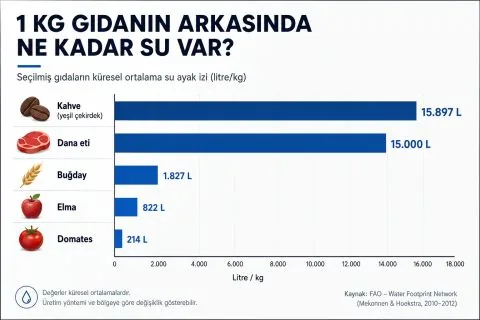
When we look at the global average water footprint in the production of one kilogram of a product, the picture becomes much more striking.
✓ 1 kg coffee (green bean): about 15.897 liters
✓ 1 kg beef: about 15.000 liters
✓ 1 kg wheat: about 1.827 liters
✓ 1 kg apple: about 822 liters
✓ 1 kg tomato: about 214 liters
Of course, these are global averages. They can differ in important ways according to climate, geography, production method, and irrigation system. But the story the figures tell does not change. Behind a food, a large water system that we often cannot see is at work.
From the sowing of the seed to the harvest, from livestock farming to feed production, from irrigation to the processing stages, and another piece of data put forward by FAO makes the issue even more important.
About 1,2 billion people live their lives in agricultural areas where serious water constraints are experienced.
On one side, the pressure on water resources is increasing, while on the other side we are trying to feed a growing world population from the same planet. One of the debates about food is right here. Today we ask a product's price, its kilos, its calories, its protein, and we examine its contents.
How much water did we use to produce this food? I wonder how many people ask that? The way I look at it is this: when we waste food, we are not only throwing that product away.
We also lose the labor of the farmer who grew it, the energy that was used, the soil's capacity to produce, and the invisible water behind that product. For this reason, the food innovation of the future will not consist only of developing products that are tastier, more functional, or more nutritious. One of the big questions is, can we produce more nutritional value by using fewer resources?
Because the true cost of a food is set not only by the price we pay at the checkout, but also by the water trace it leaves behind.
Related pages: all articles, our protein page.