Humanity learned to store food. Was it able to store its knowledge?
Today, while traveling for a business trip, I saw a group of farmers gathered at the edge of a field by the roadside.
I stopped the vehicle.
As I watched them for a while, something quite different crossed my mind. How much knowledge is there, in the memory of the people standing in front of me right now, that exists in no database?
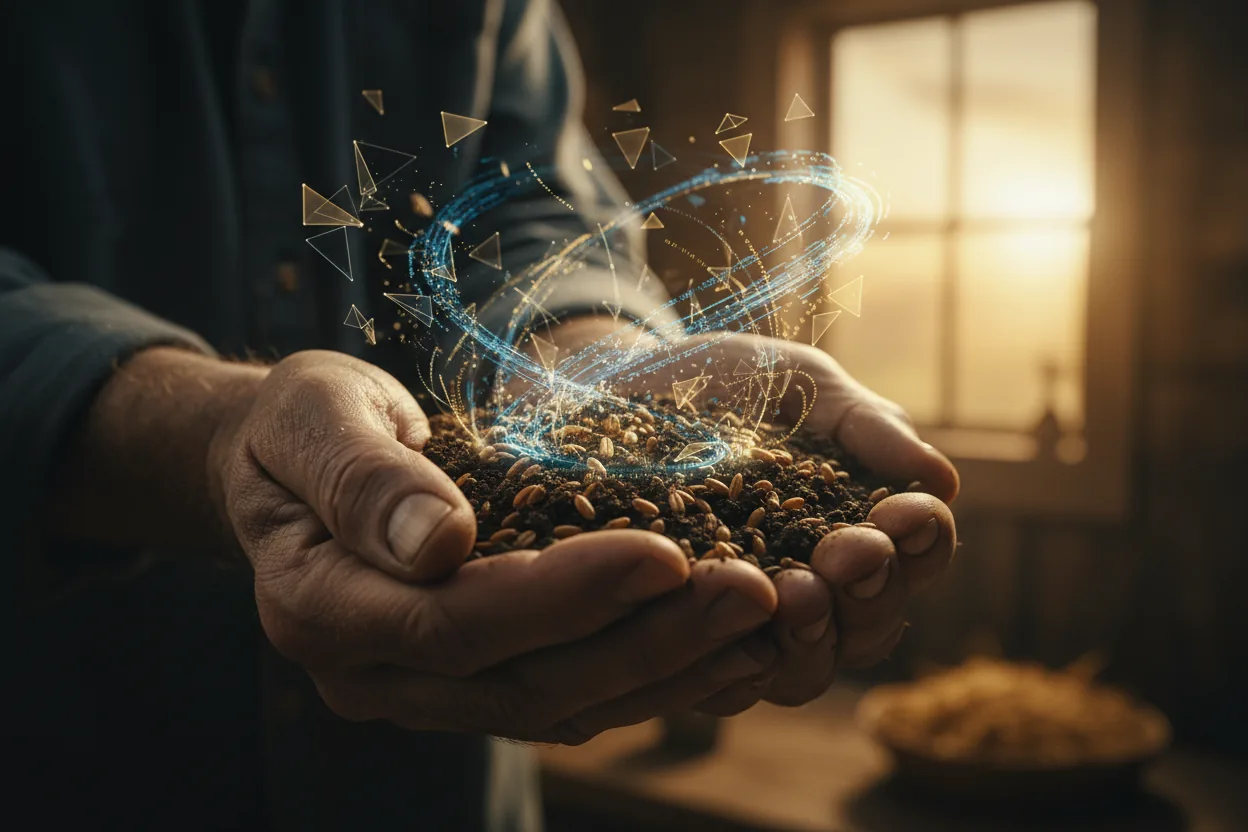
Because here we are not talking only about farming or a recipe. There were once people in a village who knew which herb to gather, and when. There were masters who knew which wheat grew better in which soil, which seed would withstand which climate, how a dough would behave according to the weather, and how a food would be fermented.
What's more, an important part of this knowledge was never written down in books. It was passed from person to person, from master to apprentice, from father to son, from mother to daughter, from farmer to farmer.
In other words, for thousands of years humanity sowed not only seeds, but knowledge too, from generation to generation. But today some links of that chain are slowly breaking.
Today, food technology in the world is more advanced than it has ever been. We have artificial intelligence, sensors, automation, genomics, and systems that can store billions of data points in seconds.
But a very interesting paradox appears here. Our capacity to store information is at perhaps the highest level in the history of humanity, and yet we are losing some traditional food knowledge.
Because not all knowledge is data.
Sometimes it is a farmer taking the soil in hand and understanding its moisture, sometimes a person who has sown the same field for years looking at the sky and sensing what will happen a few days later, sometimes a master touching the dough and understanding whether the water is enough, and sometimes a method of production whose measure is written in no book, passed down from generation to generation.
That is why, when a recipe is lost, it is not only a dish that is lost. Sometimes hundreds of years of observation, trial, error, climate, soil, and geographical knowledge are lost with it.
Today, standing at the edge of that field, I thought about this once again: perhaps some of the most valuable food archives of the future still reside not in computers, but in people's memory.
And before it disappears together with those people, this knowledge needs to be recorded, brought together with science, and passed on to future generations. In my view, food innovation is not only the production of new knowledge. It is also being able to understand the thousands of years of knowledge from the past, protect it, and carry it into the future with technology.
Because sometimes, in order to build the future, we need to notice the knowledge we are about to leave behind before we look any further ahead.
Related pages: all articles.